

Case Study
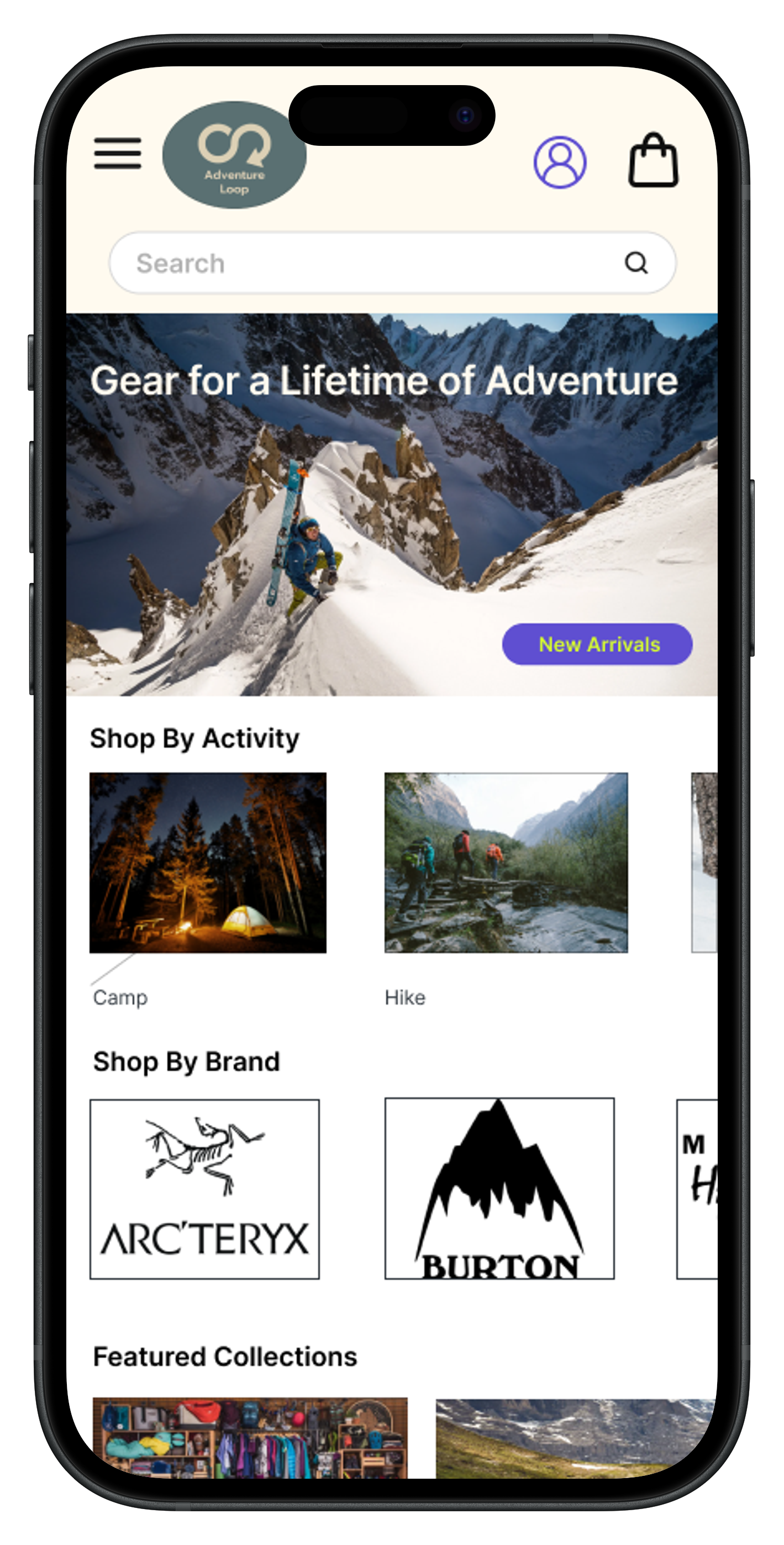
Secondhand outdoor gear is affordable and sustainable, but only if buyers trust what they’re getting. A full UX design for Adventure Loop, a resale platform built to earn user trust as a secondhand marketplace.
Adventure Loop was designed to make outdoor recreation more affordable and environmentally conscious, addressing the key shortcomings of existing resale competitors: poor navigation, cluttered interfaces, and limited product variety. The core challenge was building trust in a new, unestablished platform selling secondhand gear. The primary goals were to increase conversion through simplified navigation, give users confidence in the gear vetting process, and deliver an experience on par with established outdoor retailers. The target audience is adults aged 25–35 who are budget-conscious, environmentally motivated outdoor enthusiasts comfortable with ecommerce, users who want the economics and ethics of secondhand without sacrificing the shopping experience.
Adventure Loop's primary direct competitors are outdoor gear resale platforms, both general and brand specific. The table below outlines key differentiators across product overview, features, mobile experience, competitive advantages, and weaknesses.
| Brand | Product Overview | Feature Analysis | Mobile Experience | Competitive Advantage | Weaknesses | |||||
|---|---|---|---|---|---|---|---|---|---|---|
| Adventure Loop | Outdoor gear resale marketplace | Category filters, condition details, multiple images | Modern, responsive, mobile optimized interface | Outdoor resale focus with product variety | New, unestablished brand | |||||
| Direct Competitors | ||||||||||
| Geartrade | Outdoor gear resale marketplace | Gear filters, product variety | Responsive but dated interface | Large resale inventory | Cluttered interface | |||||
| Patagonia Worn Wear | Patagonia certified used gear | Condition certified, repair program | Clean responsive ecommerce | Strong sustainability brand | Brand-limited inventory | |||||
| Cotopaxi x Thredup | Cotopaxi apparel resale | Size filters, sorting tools | Mobile optimized resale platform | Brand resale partnership | Brand-limited inventory | |||||
| Arc'teryx ReBird | Arc'teryx repair and resale program | Repair program | Modern responsive ecommerce | Premium gear refurbishment | Brand-limited inventory | |||||
| The North Face Renewed | Refurbished North Face gear | Condition certified | Clean responsive retail design | Trusted brand quality | Brand-limited inventory | |||||
| Indirect Competitors | ||||||||||
| REI Re/Supply | Used gear resale program | Ability to view in person | Strong responsive retail UX | Retail + resale ecosystem | Limited inventory, in person only | |||||
| Facebook Marketplace | Peer-to-peer resale marketplace | Basic search, messaging tools, view in person | Strong mobile app experience | Large user network | Potential low trust, in person only | |||||
| Poshmark | Social fashion resale marketplace | Brand filters, social selling | Mobile-first marketplace design | Large resale community | Not outdoor-focused | |||||
| Depop | Trend-driven resale marketplace | Social discovery browsing | Highly optimized mobile app | Popular with younger users | Not outdoor-focused | |||||
Adventure Loop's brand tone is sustainable, adventurous, accessible, and trustworthy. The brand reflects values of environmental sustainability, spreading awareness of secondhand shopping's positive impact, making outdoor recreation accessible, maintaining natural environments for future generations, and pursuing adventure in the outdoors. The visual identity draws directly from natural environments.
The Adventure Loop logo was designed to reflect the outdoor lifestyle and sustainability through its iconography. The arrow infinity loop implies recycling while mimicking the shape of a ski path, connecting the brand's environmental ethos to the action sports world. The color palette conveys trust and connection to nature through earth tones.
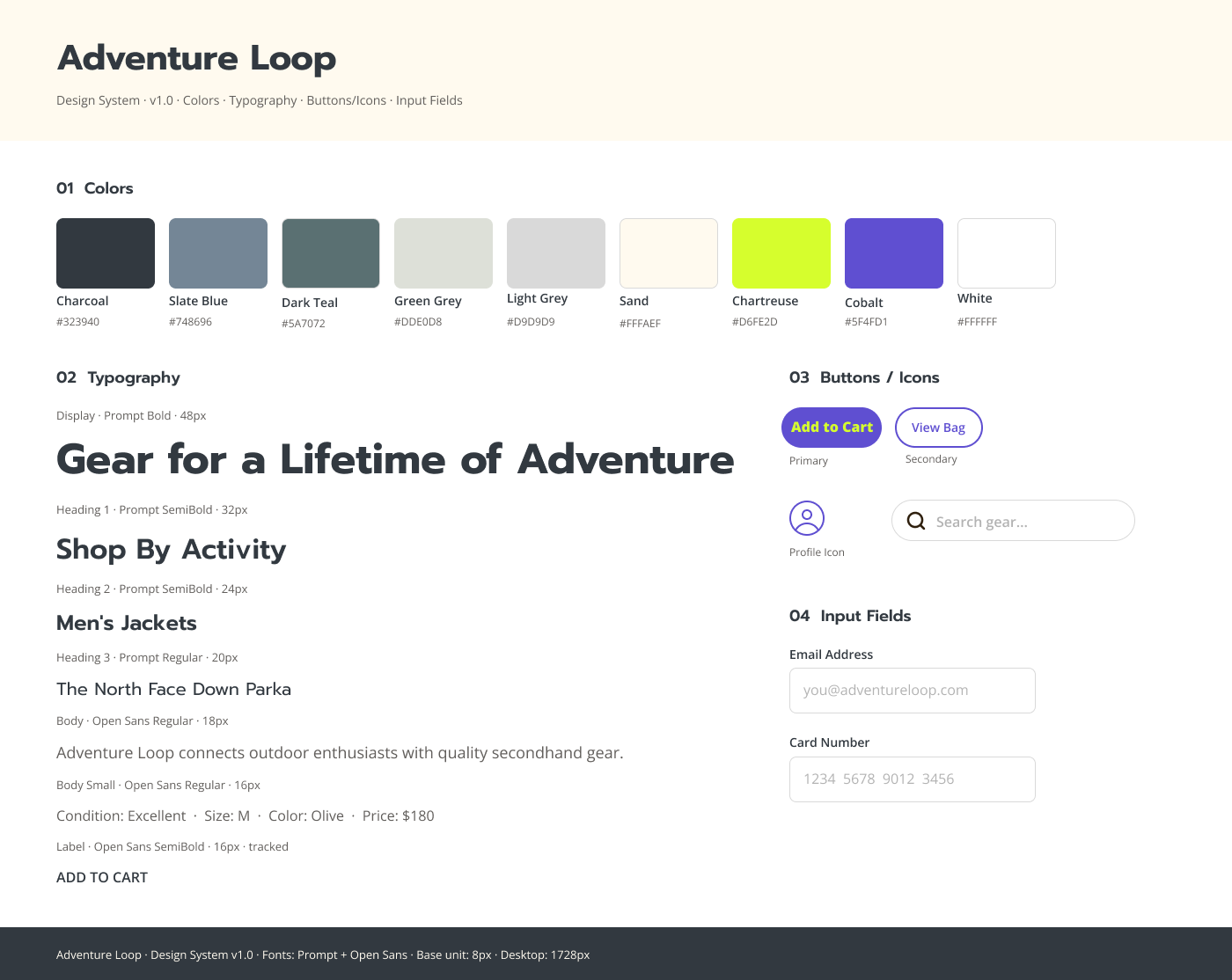
The primary palette consists of sage green, slate blue, dark teal, and light sand, which are muted earth tones evoking natural environments, trust, and calm. These are used in the logo and main site elements including the navigation header, menus, and background cards. The secondary palette uses chartreuse and cobalt blue as accent colors to reflect the energy of action sports, applied to icons, CTA buttons, and text highlights.
Headings use Prompt, a geometric sans-serif typeface with condensed, rounded letters. Body text uses Open Sans, a sans-serif known for high legibility and a neutral, modern appearance. Together they contribute to the clean, modern aesthetic and accessibility of the site. The minimum body text size of 18px also supports readability and WCAG 3.0 AAA compliance.
A moderated remote usability study was conducted with 6 participants (2 women, 4 men, aged 25–35) via Zoom. All participants had experience with ecommerce, outdoor recreation, and buying secondhand gear. Six tasks focused on site navigation were administered using a think-aloud protocol, followed by moderator debrief questions.
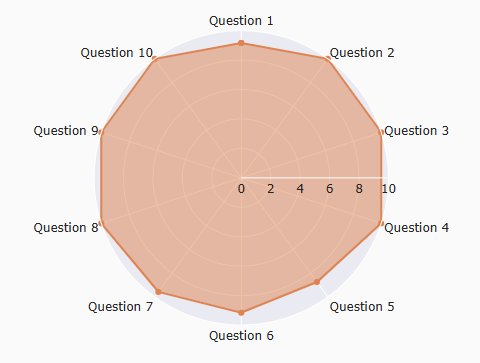
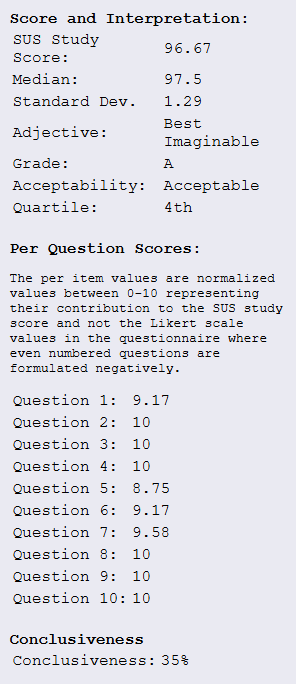
Primary metrics included Task Success Rate, Error Rate, Single Ease Question (SEQ) scores assessed after each task, and posttest System Usability Scale (SUS) scores. Secondary metrics included self-reported satisfaction ratings and time on task. SUS score results are depicted below.
All 6 participants successfully completed all tasks, though some took indirect paths. High priority issues included difficulty locating secondary product categories, uncertainty when returning to the homepage, and extra steps added by navigating to checkout instead of the shopping bag. Lower priority, but still crucial, issues included the lack of ability to filter by product type and lack of detail on product cards.
Based on usability testing findings, the following design changes were made in iteration v1.2:
These improvements are expected to result in a higher task completion rate, fewer navigation errors, and improved overall user satisfaction and perceived usability. With the primary issues addressed, task completion time is also anticipated to trend toward the standard ecommerce session average of 2–5 minutes.
Decision 01
Early testing showed users relying on the search bar to navigate categories, even when browsing. As research showed users expected activity based groupings rather than product type groupings, I structured navigation around activities (hiking, climbing, cycling) and introduced hover-to-expand subcategories, reducing navigation errors and matching the mental model users already brought to the task.
Decision 02
Trust is the primary barrier for secondhand marketplaces. I debated leading with price and availability, as direct competitors do, but research consistently showed that unfamiliar users needed credibility signals before they would engage with product listings. I prioritized hero imagery, high-contrast CTAs, and prominent user reviews on the homepage and listing pages, treating trust as a prerequisite to conversion.
Decision 03
Purchase hesitation in secondhand gear centers on condition uncertainty. I considered a simple text condition label (Good, Fair, Poor), but users in testing could not reliably interpret those labels without context. Instead, I designed listings to include multiple consistent photos and standardized condition descriptions with specific criteria, reducing the cognitive work required to evaluate whether a listing was worth clicking.
The navigation was designed with a horizontal top bar for category hierarchy and a header search field, allowing users to find products efficiently. Large visual product categories were organized by activity, brand, and featured seasonal categories and clearance. The navigation menu was later updated to follow a hover-to-expand interaction, separating main categories from subcategories to match user mental models.
A large hero image draws the eye to the tagline and primary CTA button. High contrast colors and consistent typography reinforce visual hierarchy across the site. Differentiated heading and body text, combined with intentional use of whitespace and grouping, help users navigate related categories with ease.
User reviews are prominently displayed as social proof, and high quality imagery maintains a consistent, professional aesthetic. The site's modern, clean layout mirrors the standards set by established outdoor brands, building trust in a new platform selling secondhand gear.
The final app layout was designed to reflect usability principles. It establishes clear entry points on the welcome screen with clear button hierarchy, persistent back navigation and breadcrumbs for better understanding of the site architecture, and an easy to navigate menu that always appears in the top header as well as footer links.
All 6 participants successfully completed all tasks. The prototype achieved a SUS score of 96.67, rated Best Imaginable. The median score was 97.5 with a standard deviation of 1.29, indicating highly consistent satisfaction across participants.
The design improvements made in v1.2 directly addressed high priority issues identified in testing: navigation errors from unclear category groupings, users getting stuck at the end of the checkout flow, and insufficient product detail on listing cards.
Since Adventure Loop was a concept project, engineering feasibility or client scope were not constraining factors. However, this meant there was no real user feedback or impact metrics on the shipped product. The most meaningful gap I'd address with more time is the product condition experience. The current design uses a text based condition label, but research consistently showed that condition uncertainty is the primary trust barrier in secondhand shopping. A color coded condition scale with standardized criteria, combined with mandatory imperfection photography as part of the seller listing flow, would give buyers significantly more confidence before committing to a purchase.
I also would have prioritized usability testing on the final design. The prototype was evaluated at an earlier stage, and while the SUS score of 96.67 was strong, those results reflect the mid-fidelity experience rather than the final product with its updated navigation and listing pages. Testing the shipped design would have let me validate whether the changes made in response to earlier findings actually resolved the issues, or introduced new ones. That feedback loop is something I'd build in from the start on future projects rather than treating it as a phase that happens if time allows.